5 Most Common Tenses
In the previous blogs, we learned:
- how to structure a sentence,
- how articles work,
- how prepositions show time, place, direction, and manner.
Now we answer the most feared question:
Which tense should I use?
Which verb form (V1, V2, V3) should I choose?
This blog will fix that logically, not by memorization.
One important truth (read this slowly)
Tense is decided by time and relevance,
not by sentence length or difficulty.
English mainly asks:
- When did it happen?
- Does the result matter now?
- Is it still continuing?
The only 5 tenses you need first
You do not need 12 tenses to speak correct English.
Start with these 5 most common tenses.
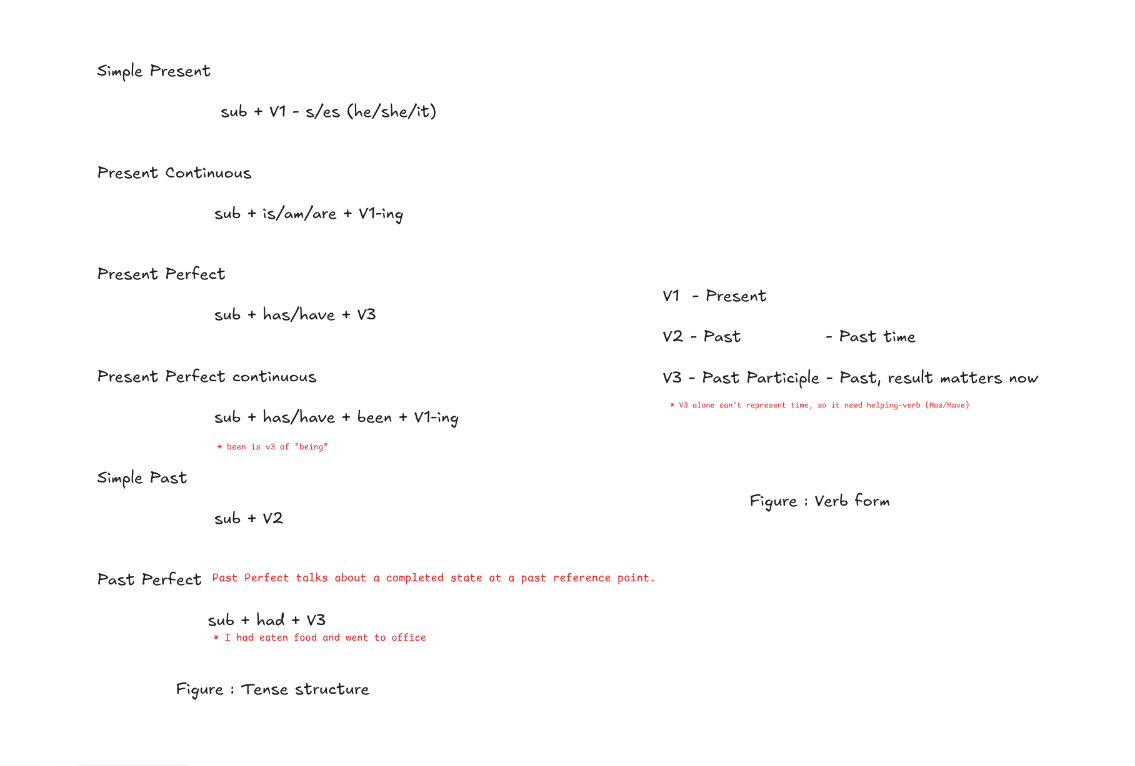
1. Present Simple — habits and facts
Use when:
- the action is regular
- the action is generally true
Structure:
- Subject + V1
- Subject + V1 + s/es (for he/she/it)
Examples:
- I study daily.
- She works in an office.
- They play football.
- We eat rice at night.
2. Present Continuous — happening now
Use when:
- the action is happening right now
- the action is temporary
Structure:
- Subject + Be-verb (is/am/are) + V1 + ing
Examples:
- I am studying now.
- She is working today.
- They are watching TV.
3. Past Simple — finished in the past
Use when:
- the action is completely finished
- the time is past (even if not mentioned)
Structure:
- Subject + V2
Examples:
- I studied yesterday.
- She joined the company last year.
- We completed the project.
4. Present Perfect — result matters now
This tense confuses many learners.
Use when:
- the action happened in the past
- but the result is important now
Structure:
- Subject + have/has + V3
Examples:
- I have completed my degree.
- She has joined the company.
- We have finished the task.
Think like this:
The action is past, but the impact is present.
5. Present Perfect Continuous — duration till now
Use when:
- the action started in the past
- it is still continuing
- you care about how long
Structure:
- Subject + have/has been + V1 + ing
Examples:
- I have been studying for 3 hours.
- She has been working here since 2022.
Verb forms: V1, V2, V3 (no fear)
Verbs have three forms, but you never choose randomly.
| Form | Meaning | Used with |
|---|---|---|
| V1 | base / present | present simple |
| V2 | past | past simple |
| V3 | past participle | have / has / had |
Golden rule (very important)
If you see
have,has, orhad,
the verb must be V3.
No exception at beginner level.
Common verb table (do not memorize in one day)
| V1 | V2 | V3 |
|---|---|---|
| go | went | gone |
| do | did | done |
| make | made | made |
| eat | ate | eaten |
| write | wrote | written |
| read | read | read |
| see | saw | seen |
| take | took | taken |
| come | came | come |
| give | gave | given |
Use this table as a reference, not as homework.
How to choose the correct verb form (step-by-step)
Ask these questions in order:
Step 1: Is the sentence about now, past, or habit?
- habit → Present Simple → V1
- now → Present Continuous → V1 + ing
- past finished → Past Simple → V2
Step 2: Does the result matter now?
- yes → Present Perfect → have/has + V3
- no → Past Simple → V2
Step 3: Is duration important?
- yes → Present Perfect Continuous
How to form a full sentence (final recipe)
You already know structure, articles, and prepositions.
Now combine everything.
Sentence factory:
- Subject
- Verb (tense decides form)
- Object (if needed)
- Article (a / the, if noun appears)
- Details (manner → place → time)
Example 1
I have completed the course successfully at home recently.
Example 2
She is preparing for the interview seriously at night.